


Follistatin
Follistatin – The Next-Generation Muscle Growth Peptide
Follistatin is an advanced muscle-building peptide that has gained global attention for its ability to enhance muscle growth, increase strength, and support faster recovery. Originally discovered for its role in reproductive and tissue regulation, Follistatin is now one of the most promising biological tools in bodybuilding and performance enhancement.
Follistatin works by inhibiting myostatin, a natural protein that limits muscle development. When myostatin activity is blocked, the body can build lean, dense, and powerful muscles far beyond normal physiological limits.
Key Benefits of Follistatin:
-
Promotes rapid lean muscle mass growth
-
Improves muscle recovery and reduces downtime between workouts
-
Enhances endurance and physical performance
-
May help reduce body fat by improving metabolic efficiency
-
Supports tissue regeneration and cellular repair
Because of its scientifically backed mechanism, Follistatin has become a top choice among athletes, bodybuilders, and researchers exploring peptide-based muscle enhancement.
When used responsibly and under guidance, Follistatin can serve as a powerful, research-grade supplement for those aiming to reach new heights in muscle performance and recovery.
Frequently Asked Questions (FAQs)
1. What is Follistatin and how does it work?
Follistatin is a naturally occurring glycoprotein that blocks the action of myostatin, a protein that limits muscle growth. By inhibiting myostatin, Follistatin allows muscles to grow larger and stronger, making it a popular compound in both medical research and athletic performance enhancement.
2. Is Follistatin safe to use?
When used for research or under medical supervision, Follistatin has shown a good safety profile in studies. However, as with any peptide, dosage and purity are critical. Users should always source Follistatin from reliable, laboratory-verified suppliers to ensure safety and authenticity.
3. How long does it take to see results from Follistatin?
Results may vary depending on dosage, cycle duration, and training intensity. Many users report visible increases in muscle fullness and strength within 3–6 weeks of consistent use, especially when combined with proper nutrition and resistance training.
4. Can Follistatin be stacked with other peptides or anabolic compounds?
Yes. Follistatin is often stacked with growth-oriented peptides such as IGF-1, GHRP-6, or CJC-1295 for enhanced anabolic effects. However, stacking should always be done carefully, and preferably under the guidance of a health or fitness professional to avoid overstimulation or imbalanced results.

Follistatin 344 | 1 mg (Myostatin Inhibitor)
Follistatin (specifically the FST-344 isoform) is a potent autocrine glycoprotein that plays a critical role in the regulation of muscle mass. It functions primarily as a high-affinity binding protein for Activin and Myostatin. By sequestering these proteins into inactive complexes, Follistatin allows for muscle growth beyond the body’s natural genetic limitations.
This 1 mg vial contains a high-purity recombinant version of the endogenous protein, designed for targeted tissue growth and rapid physical recovery.
Mechanism of Action
Follistatin works through a complex signaling pathway to promote anabolism:
-
Myostatin Inhibition: It binds directly to Myostatin (GDF-8), a TGF-beta protein that restricts muscle growth. By blocking Myostatin, Follistatin allows for increased muscle fiber hypertrophy and hyperplasia.
-
Activin Sequestration: It neutralizes Activin, preventing aberrant cell overgrowth and regulating follicle-stimulating hormone (FSH).
-
Anti-Inflammatory Modulation: Research suggests Follistatin can downregulate systemic inflammation, making it a subject of study for conditions like asthma and colitis.
Role in Performance & Bodybuilding
-
Rapid Muscle Mass Gains: By removing the "brakes" (Myostatin) on muscle development, it facilitates substantial increases in lean body mass.
-
Enhanced Strength: Supports explosive power and strength gains by increasing muscle fiber density.
-
Advanced Recovery: Drastically reduces the time required for muscle repair following high-intensity training sessions.
-
Synergy: Often used in cycles where athletes aim for extreme hypertrophy that cannot be achieved through traditional anabolic agents alone.
Product Specifications
Administration & Side Effects
-
Administration: Typically administered via subcutaneous or intramuscular injection.
-
Dosage: Must be individually calculated. Common protocols in research settings often involve 100 mcg per day or a large single dose every few days during a short cycle (e.g., 10 days).
-
Potential Side Effects: May include temporary joint or tendon soreness (due to rapid muscle growth), cardiac hypertrophy (at extreme doses), and potential impacts on the reproductive axis (hypogonadism).
Storage & Handling
-
Unreconstituted: Keep refrigerated (2°C - 8°C) for long-term stability. Avoid exposure to direct light and heat.
-
Reconstituted: Use Bacteriostatic Water for mixing. Once dissolved, the peptide becomes highly fragile; must be kept refrigerated and used within a short window (typically 7–10 days) for maximum efficacy.
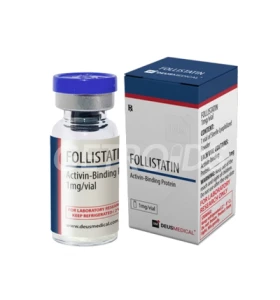

FOLLISTATIN 1 Deus Medical
Active Substance: Follistatin (Activin-Binding Protein)
Manufacturer: Deus Medical
Pack: 1 Vial x 1 mg
What Is Follistatin?
Follistatin is a recombinant (synthetic) version of the endogenous glycoprotein that occurs naturally in the body.1 Its primary role is as an Activin-Binding Protein, which binds to proteins involved in cell growth and regulation.
Developed through research targeting cell growth and regulation, Follistatin is widely known in the performance world for its unique ability to counteract growth inhibitors, potentially offering immense value for muscle development and longevity.
Core Mechanisms and Role in Bodybuilding
Follistatin's complex action involves neutralizing multiple ligands from the TGF-2$\beta$ superfamily, providing two distinct pathways for enhanced muscle growth:3
-
Myostatin Inhibition (Primary Role): Follistatin acts as a potent inhibitor of Myostatin, a protein that naturally limits muscle size and prevents excessive growth.4 By binding to and sequestering Myostatin, Follistatin helps unlock muscle growth potential beyond the body's genetic ceiling.
-
Activin Inhibition: It also binds to Activin, a protein that can suppress muscle growth and induce aberrant cell growth.5 By neutralizing Activin, Follistatin further supports muscle hypertrophy and regeneration.6
Additional Benefits
-
Recovery and Regeneration: Follistatin supports recovery by promoting satellite cell proliferation (muscle stem cells) and enhancing the regeneration of damaged muscle fibers.7
-
Anti-Inflammatory Action: It is being investigated for its ability to downregulate inflammation in diseases like asthma and colitis, suggesting a broad anti-inflammatory effect.8
-
Fertility Axis Interaction: Follistatin's initial discovery was due to its ability to suppress Follicle-Stimulating Hormone (FSH) secretion via Activin.9 This indicates a potent interaction with the hypothalamic–pituitary–gonadal axis.
Usage, Dosage, and Risks
Follistatin's potent mechanisms demand extreme caution and individualized protocols.
-
Dosage: The dose of Follistatin should always be taken by a physician, individually calculated for individual needs and health conditions. Research dosages vary widely (often $1 \text{ mg}$ per day or $\text{mg}$ per week, administered via injection), reflecting its powerful effect.
-
Administration: Typically administered via intramuscular or subcutaneous injection, as peptides are broken down in the stomach.
-
Interactions: Follistatin is reported to interact with other regulatory proteins like inhibin.10
Side Effects and Precautions
Due to its powerful role in regulating cell growth, Follistatin carries significant potential risks.11
-
Hypogonadism Risk: By suppressing 12$\text{FSH}$ via Activin, Follistatin raises concerns for potential adverse effects on the Hypothalamic-Pituitary-Gonadal (HPG) axis, which could lead to hypogonadism (low sex hormone production).13
-
Cardiovascular Risks: Complete Myostatin inhibition, particularly with long-term use, has raised concerns about cardiac hypertrophy (enlargement of the heart muscle), which can compromise cardiovascular health.14
-
Psychological Effects: Potential side effects include depression and anxiety.
-
General: Altered lipid profiles and the potential for inducing or aggravating aberrant cell growth (cancer) must be considered.
Frequently Asked Questions (FAQs)
1. What is the biggest advantage of Follistatin in bodybuilding?
The biggest advantage is its action as a Myostatin Inhibitor.15 Myostatin acts as a genetic brake on muscle growth. By neutralizing Myostatin, Follistatin can potentially allow users to build muscle mass beyond their natural genetic limits, leading to both hypertrophy (increase in fiber size) and hyperplasia (increase in fiber number).
2. Why is Follistatin not widely approved for human use if it causes muscle growth?
The primary barrier to approval is the lack of long-term human safety data and the potential for severe off-target effects. Its interaction with the Activin-Inhibin axis raises caution regarding hypogonadism and fertility.16 Most critically, its powerful action on cell growth raises fears of promoting the growth of latent or existing tumors, leading to cardiac hypertrophy with long-term use.17
3. Does Follistatin need to be stacked with a steroid or testosterone?
Follistatin's action is independent of the androgen receptor, so it does not rely on traditional steroids. However, given the concerns about its potential to suppress $\text{FSH}$ and affect the $\text{HPG}$ axis, any Follistatin cycle requires careful hormonal monitoring. It is often stacked with other components to maximize muscle-building pathways.
4. What is the difference between Follistatin and the peptide YK11?
Both are Myostatin Inhibitors, but they work differently. YK11 works by stimulating the gene that produces Follistatin, making it an indirect Myostatin Inhibitor. Follistatin is the recombinant protein itself, which directly binds to and neutralizes Myostatin and Activin, making it a direct antagonist.

Follistatin (Activin-Binding Protein) XT Labs USA
Product Overview
-
Manufacturer: XT Labs USA
-
Product Name: Follistatin (Activin-Binding Protein)
-
Active Substance: Follistatin (Recombinant Activin-Binding Protein)
-
Pack Size: 1 Vial × 1 mg
-
Form: Injectable Peptide (for research use only)
What Is Follistatin (Activin-Binding Protein)?
Follistatin is a recombinant version of the natural protein activin-binding protein, found in various human tissues.
It functions by binding to activin, a regulatory protein that influences cell growth, muscle development, and hormone signaling—particularly follicle-stimulating hormone (FSH).
By controlling activin activity, Follistatin helps prevent abnormal cell proliferation, which can be associated with certain cancers or tissue overgrowth conditions.
Beyond its cellular regulation role, Follistatin is being investigated for potential applications in inflammation management and muscle regeneration research.
Mechanism of Action
Follistatin works primarily through activin sequestration — it binds to activin molecules, forming an inactive complex that prevents activin from binding to its receptors.
Key Mechanisms:
-
Activin Neutralization – Inhibits activin’s ability to promote abnormal cell division or overgrowth.
-
Growth Regulation – Prevents excessive tissue development that may lead to pathological growths or tumor formation.
-
Inflammation Modulation – Helps regulate immune responses and inflammatory pathways linked to conditions such as asthma and colitis.
-
Myostatin Inhibition (Indirect) – Follistatin also binds myostatin, a natural inhibitor of muscle growth, promoting muscle fiber development and repair.
This dual regulatory action—suppressing activin and myostatin—has made Follistatin a focus of both medical and performance-based research studies.
Therapeutic and Research Applications
Follistatin is currently being studied for its broad biological roles in regulating tissue growth, inflammation, and muscle function.
1. Cancer Research
-
By binding to activin, Follistatin may prevent tumor-promoting signals associated with overactive activin pathways.
-
Research explores its use in oncology to reduce cell proliferation and metastasis potential.
2. Anti-Inflammatory Potential
-
Studies suggest Follistatin may help manage inflammatory diseases such as asthma, ulcerative colitis, and autoimmune disorders by modulating immune response and cytokine signaling.
3. Muscle Growth and Regeneration
-
Inhibiting myostatin allows muscle tissue to grow beyond normal limits, enhancing regeneration after injury.
-
This mechanism has positioned Follistatin as a target in muscular dystrophy and recovery-based research.
Role of Follistatin in Bodybuilding and Fitness Research
Follistatin has become a point of discussion in the bodybuilding and athletic community due to its potential to enhance muscle hypertrophy and reduce recovery time through myostatin inhibition.
When myostatin levels are high, muscle growth is limited; Follistatin counteracts this by neutralizing myostatin activity, allowing muscle fibers to expand and regenerate more efficiently.
Potential Performance Research Outcomes:
-
Increased Muscle Mass: By suppressing myostatin, Follistatin supports enhanced lean muscle growth.
-
Improved Recovery: Promotes faster tissue regeneration after resistance training or injury.
-
Reduced Fatigue: May improve recovery capacity by regulating inflammation and muscle repair cycles.
Caution: While promising in laboratory research, Follistatin’s use in performance enhancement lacks long-term human safety data. It should not be used without professional oversight.
Dosage and Administration
Disclaimer: Dosage should always be determined by a qualified medical or research professional. Information below is for educational reference only.
General Research Guidelines
-
Form: Injectable peptide (reconstituted with bacteriostatic water)
-
Typical Range: Individually calculated by a physician or researcher
-
Administration Route: Subcutaneous or intramuscular injection
-
Frequency: Depends on specific research objectives and health conditions
Because Follistatin affects multiple hormonal and cellular pathways, precise dosage control is crucial to prevent systemic imbalance or undesired growth effects.
Possible Side Effects
While Follistatin demonstrates potential therapeutic benefits, it can also influence hormone and cell regulation systems, leading to side effects if misused or overexpressed.
Reported or Potential Side Effects:
-
Hypogonadism: Suppression of gonadal hormone function
-
Cardiac Hypertrophy: Possible enlargement of heart tissue with prolonged use
-
Mood Changes: Anxiety or depressive episodes due to hormonal shifts
-
Altered Lipid Profiles: Increase in LDL or reduction in HDL cholesterol levels
-
Metabolic Disturbances: Changes in insulin sensitivity
If any side effects are experienced, discontinuation and immediate medical consultation are essential.
Interactions
-
Inhibin Interaction:
Follistatin interacts with Inhibin, another protein that regulates cell growth and reproductive hormones.
These interactions can influence overall endocrine balance and should be monitored in research settings. -
Other Peptides and Hormones:
Combining Follistatin with growth factors or anabolic agents may amplify results but increase the risk of unwanted cellular effects.
Strict medical supervision is mandatory for any such combination studies.
Safety and Precautions
Avoid Use If You:
-
Are pregnant or breastfeeding
-
Have a history of cancer or tumors
-
Suffer from heart, kidney, or liver disorders
-
Are under 25 years old (may affect natural hormonal development)
Storage Guidelines
-
Store in a cool, dry place (2–8°C) before reconstitution.
-
After reconstitution, refrigerate and use within 7–10 days.
-
Do not freeze the solution.
-
Keep away from light and heat.
Summary
Follistatin (Activin-Binding Protein) by XT Labs USA is a recombinant peptide designed for research on activin regulation, inflammation control, and muscle growth mechanisms.
By binding to activin and myostatin, it plays a critical role in cell growth moderation, muscle regeneration, and immune response regulation.
While Follistatin shows significant promise in both medical and performance-related research, it remains a research-only compound with unproven long-term safety for human therapeutic use.
All handling and experimentation should be conducted responsibly, under professional supervision.
Important Reminder
Please note that XT Labs USA is a UGL (Underground Lab) brand. These are not pharmagrade products, but each batch is tested for purity and potency.
If used alongside SARMs, growth peptides, or other research compounds, ensure to follow proper cycle management and post-use monitoring protocols when applicable.